
Core question: What actually makes AI useful in a working team? This JX Lab field note starts with a system map rather than a long list of generic tips.
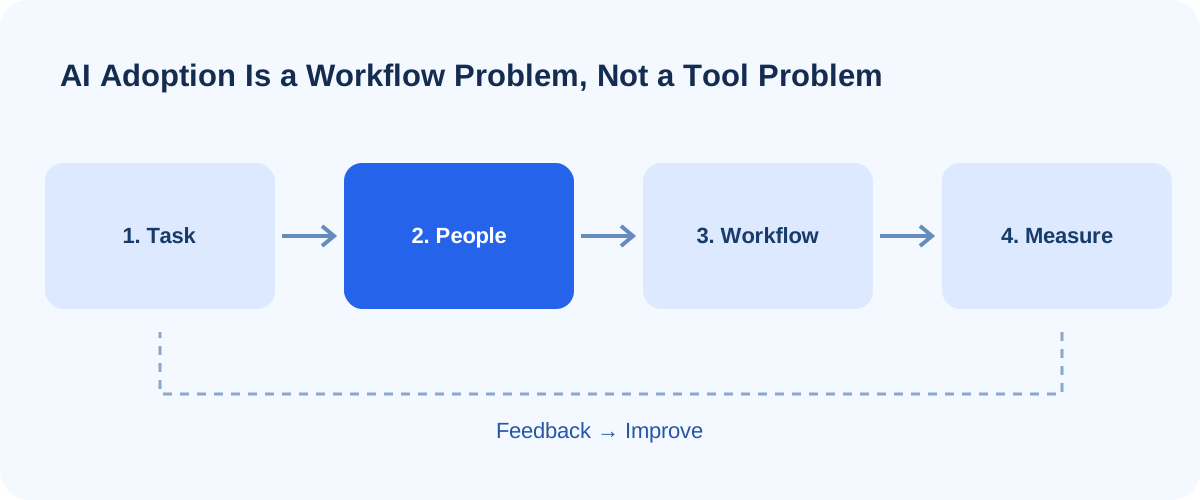
Understand the flow before choosing the tools
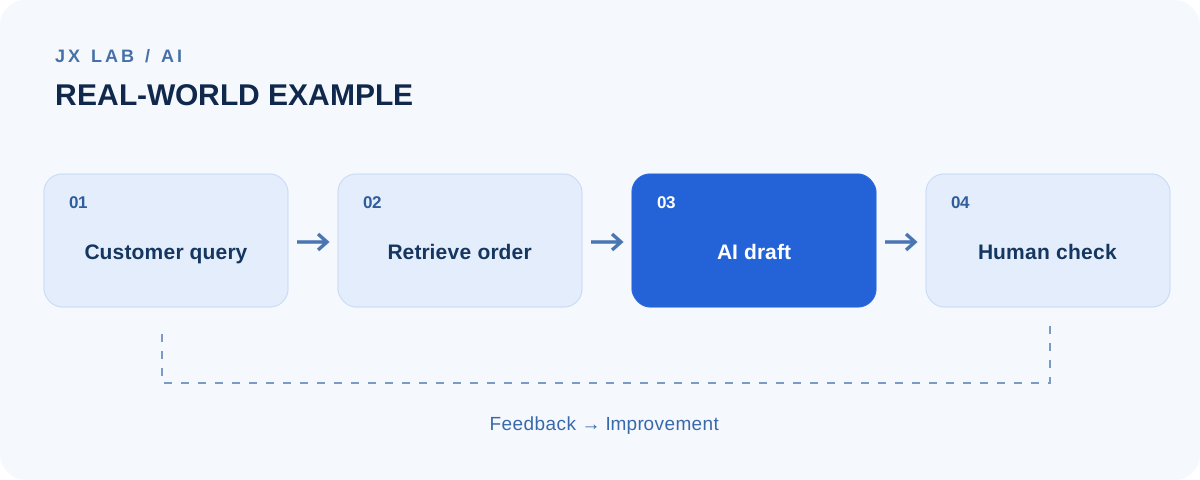
Imagine a support team handling order-tracking inquiries. Instead of introducing an AI assistant and hoping agents use it, map the actual flow: customer message → identify order → verify tracking source → propose response → human approval → send → monitor exceptions. The valuable artifact is the workflow with explicit responsibilities.
Inspect each node
- Start with a real task. Choose a repeated task with a known owner, input and expected output. Avoid starting with a model comparison.
- Give people a clear role. Define who drafts, reviews, approves and handles exceptions. AI can assist decisions without becoming the person accountable.
- Redesign the workflow. Place the AI step inside the existing process, including handoffs, failure handling and rollback. A chatbot outside daily work is easily forgotten.
- Measure the result. Measure cycle time, correction rate, adoption and user confidence against a baseline. Track actual usage rather than licences purchased.
Where projects often go wrong
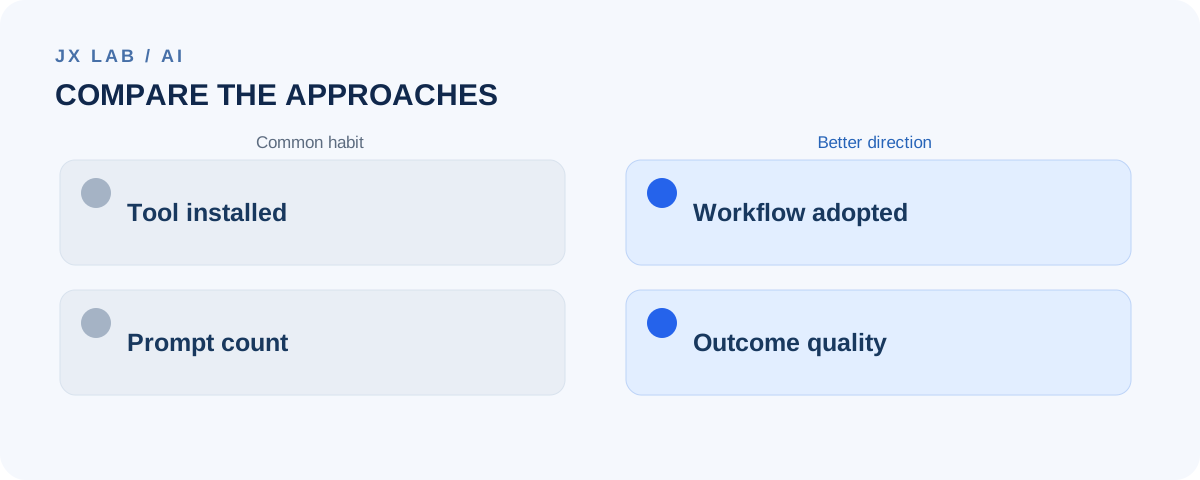
| Weak approach | Stronger approach |
|---|---|
| Buy licences first | Identify one repeatable job and its owner |
| Count prompts as progress | Measure task outcomes and rework |
| Assume full automation | Define approval and exception paths |
A practical checklist
- Can someone explain the entire flow in one diagram?
- Are the actor, inputs, outputs and exceptions explicit?
- Can we distinguish observations from assumptions?
- What evidence would change our recommendation?
Takeaway
Adoption happens when a useful capability becomes a reliable part of a team’s process. A diagram helps us see dependencies; a short explanation adds context and trade-offs. Both are needed to make the knowledge useful.
JX Lab field note: this is a practical framework based on our systems and workflow design approach, not a claim of measured improvement without a project-specific study.