
Core question: How do we know a seemingly small software change will not disrupt the rest of a business? This JX Lab field note starts with a system map rather than a long list of generic tips.
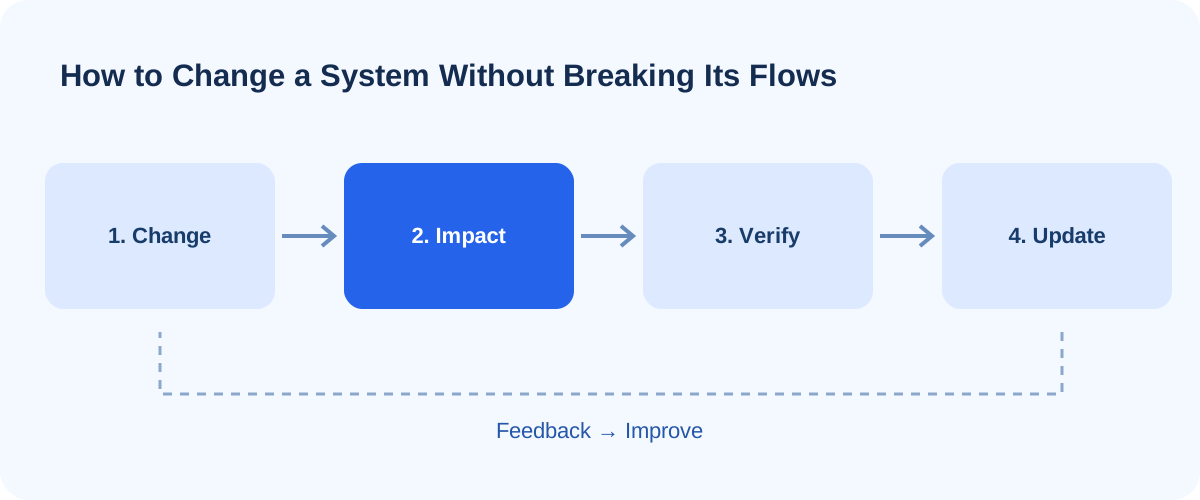
Understand the flow before choosing the tools
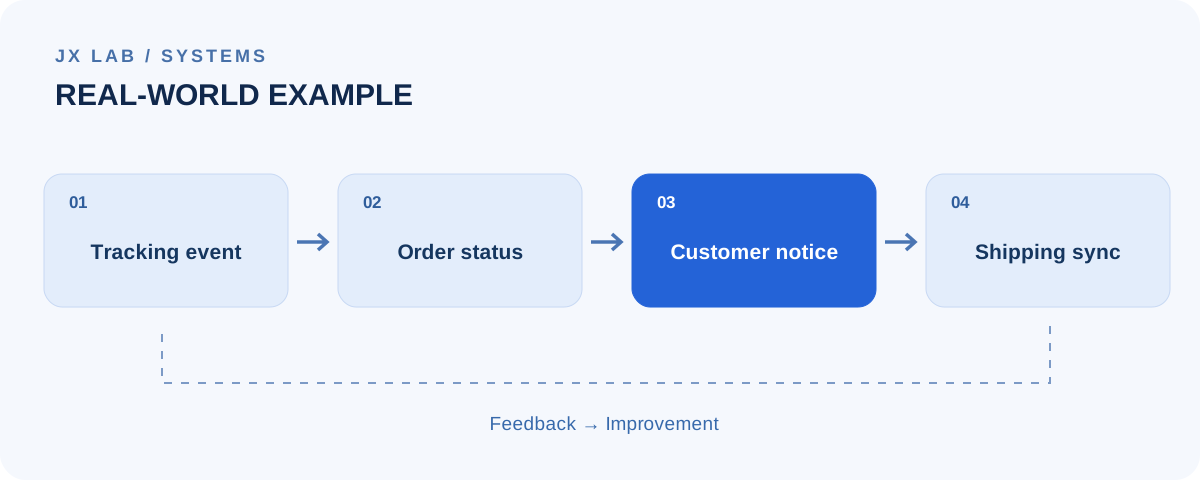
An order platform changes when supplier tracking arrives. That sounds like one webhook change—but it may affect order status, customer notifications, support visibility and the call to the shipping service. A flow map makes these effects visible before release.
Inspect each node
- Describe the change. State what behavior is changing, who requested it and which assumptions must remain true.
- Trace its impact. Follow the affected path beyond the edited component: users, events, integrations, data ownership and downstream decisions.
- Verify the journeys. Test the journeys that matter, including failure and rollback paths. Verify outcomes with evidence rather than relying on a successful deployment alone.
- Update the system map. Bring diagrams, ownership notes and constraints back in line with the shipped behavior so the next change starts with accurate context.
Where projects often go wrong
| Weak approach | Stronger approach |
|---|---|
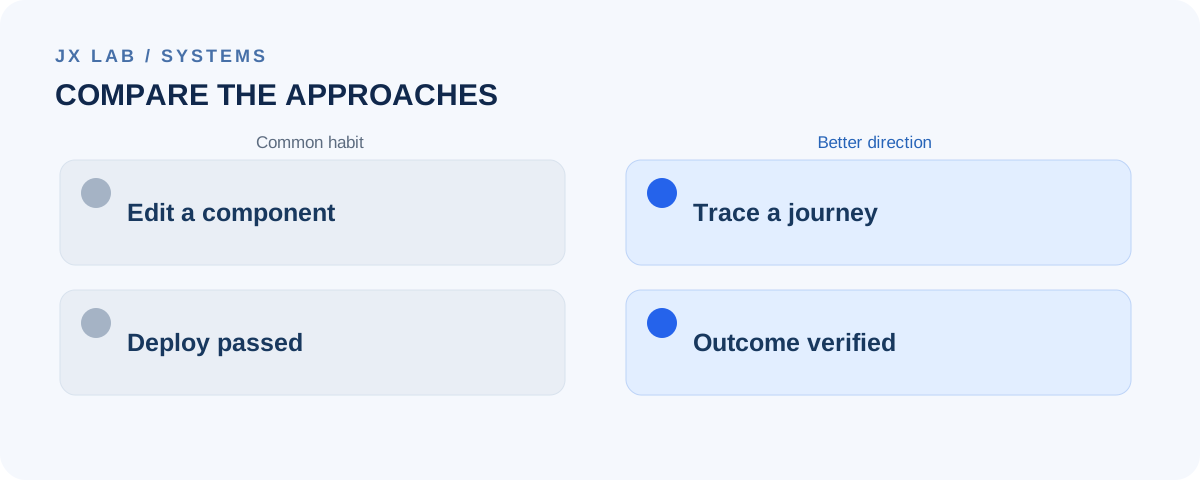
| Review only the changed file | Trace affected business journeys |
| Trust a green deployment | Verify real outcomes with evidence |
| Leave diagrams unchanged | Update the operational model after release |
A practical checklist
- Can someone explain the entire flow in one diagram?
- Are the actor, inputs, outputs and exceptions explicit?
- Can we distinguish observations from assumptions?
- What evidence would change our recommendation?
Takeaway
A safe change is not just code that works. It is a change whose consequences are understood and verified. A diagram helps us see dependencies; a short explanation adds context and trade-offs. Both are needed to make the knowledge useful.
JX Lab field note: this is a practical framework based on our systems and workflow design approach, not a claim of measured improvement without a project-specific study.